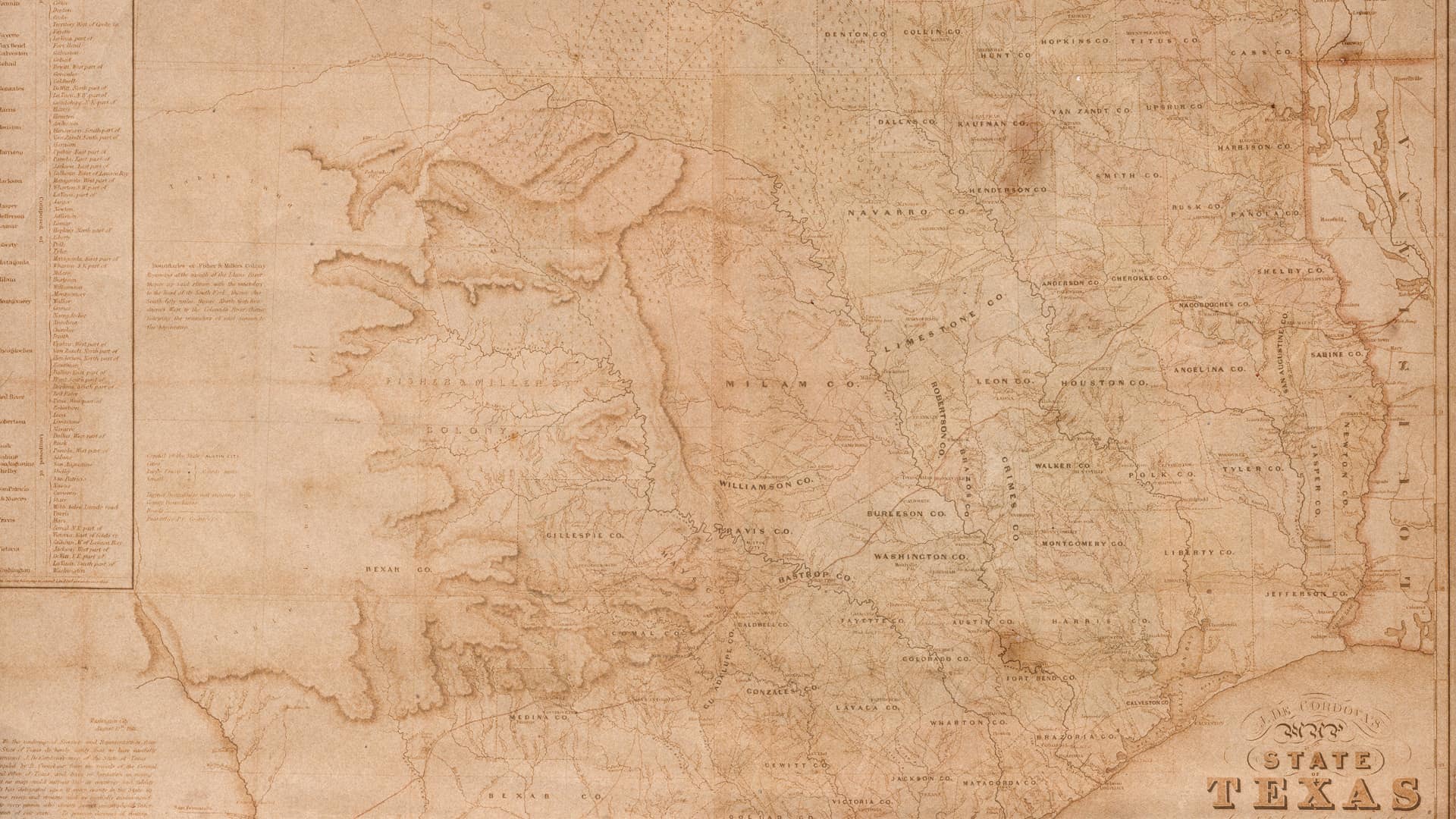
1800–1870
Tracing the forced migration
of enslaved people into Texas
An interactive map of the forced migration of enslaved people into Texas between 1800 and 1870, reconstructed from the 1867 to 1870 voter registration, in which more than 50,000 of the 140,073 Texans who registered were freedmen. Search a name, open a county, or follow the migration on the map.
Registered voters, 1867–1870
Freedmen registered
Texas counties
Enslaved in 1860
Explore the Data
Where enslaved Texans came from
The birthplaces registrants reported most often, from the 1867 to 1870 register.
| Birthplace | Registrants |
|---|---|
| Alabama | 3,162 |
| Virginia | 3,069 |
| Tennessee | 2,354 |
| Georgia | 2,343 |
| North Carolina | 1,980 |
| Texas | 1,834 |
| Mississippi | 1,800 |
| South Carolina | 1,643 |
Slavery in Texas, county by county
The counties that registered the most freedmen in 1867, with the number the 1860 census counted enslaved in each.
| County | Freedmen registered | Enslaved in 1860 |
|---|---|---|
| Harrison | 2,773 | 8,784 |
| Washington | 2,279 | 7,941 |
| Harris | 2,039 | 2,053 |
| Colorado | 1,423 | 3,559 |
| Marion | 1,374 | 2,017 |
| Walker | 1,373 | 4,135 |
| Fort Bend | 1,360 | 4,127 |
| Brazoria | 1,331 | 5,110 |
| Rusk | 1,329 | 6,132 |
| Smith | 1,318 | 4,982 |
Questions about the records
The Reconstruction Acts of 1867 required Texas to register every man aged 21 and over who would swear loyalty to the United States, Black and white alike. Boards of three registrars, with a freedman on the board wherever practical, wrote down each man's name, residence, birthplace and how long he had lived in Texas, in the county and in the precinct. The handwritten registers are held by the Texas State Library and Archives Commission and list 140,073 men across 125 counties.
Every man who registered between 1867 and 1870: more than 50,000 of them freedmen, freed only two years earlier, listed under their own names with a birthplace and the year they came to Texas. For most formerly enslaved Texans it is the earliest record in which they appear by name, three years before the 1870 census.
Many registrants reported far more years in Texas than in their county: a man might report 40 years in Texas but 20 in the county. The 20 years between were spent somewhere in Texas the register does not name.
For a man born in Virginia or Alabama, who could not have chosen where he lived before 1865, those years are the trace of sale, inheritance or forced relocation within Texas. During those years the map counts him as in Texas, county unknown, rather than guessing a county.
Search the records by surname, filter by county if you know it, and open the entry to read the original handwritten page. Spellings vary, so try the sound of a name as well as its spelling. Each entry gives a name, a birthplace and the year the man reached Texas.
The registration of 1867 was the first time Black men in Texas registered to vote, and the referendum of February 1868 was the first election in which they voted: 36,932 Black registrants voted for a constitutional convention that year.
Many registrants who named a birthplace named Alabama, Virginia, Tennessee, Georgia or the Carolinas. The origins pages rank every birthplace and show the counties that received them.